Loyalty program glossary
Plain-language definitions for the terms that show up in loyalty and gift-card programs. From accrual rate to breakage, with worked examples.
These definitions are operational, not academic. We use plain language and add an example for each. Where a term has multiple meanings across industries, we lead with the dominant reading.
Active member
A loyalty program member who has transacted with the program within a defined window — usually 30, 60 or 90 days. Programs report participation numbers as "active members" to avoid inflating metrics with dormant accounts.
Example: A coffee shop loyalty program has 1,200 signed-up members but only 480 active members in any given month (40% activation).
Breakage
A liability or balance that the issuing business reasonably expects will never be redeemed. Recognized as revenue after a defensible dormancy pattern is established, under jurisdiction-specific accounting rules.
Example: A $20 gift card sold in 2024 but never redeemed is breakage-eligible after ~24 months of dormancy, depending on jurisdiction and accounting basis.
Card-linked program
A loyalty program that ties rewards to a specific payment card (debit, credit, or stored-value). The customer does not need to "do" anything — the program runs in the background of their card transactions.
Example: A restaurant group runs a card-linked offer: "5% back when you use your linked Visa at any location, on Tuesdays."
Channel-aware rewards
A program that rewards total spend across all channels (in-store, online, mobile app, marketplace) instead of a single channel. The reward grows with the customer's aggregate behavior, not where they happened to transact.
Example: A retail loyalty program gives 1 point per $1 spent whether the purchase happened on the website, the mobile app, or at a brick-and-mortar store.
CLV
Customer Lifetime Value — the total contribution margin a business expects from a customer over the entire relationship. Loyalty programs are valued by their impact on CLV.
Example: A coffee shop customer's CLV might be $1,800 over 5 years; a loyalty program aims to extend that by raising repeat-visit frequency.
Cost of redemption
The true out-of-pocket cost of fulfilling one reward redemption. Distinct from the face value shown to the customer. The basis for reward cost ratio calculations.
Example: A "free coffee" with a $5 face value costs the coffee shop ~$1.20 in COGS. The $1.20 is the cost of redemption.
Earn rate
The rate at which a customer accrues points, stamps or other units in a loyalty program. Often expressed as points per dollar, or stamps per visit.
Example: A credit card travel program might have a 1x earn rate on dining, 2x on travel, 3x on hotels.
Engagement rate
The share of program members who interact with the program in a given period. A high engagement rate means the program is part of the customer's habit; a low rate means the program is invisible.
Example: A stamp card's engagement rate is usually measured as "issued stamp cards with ≥1 stamp added in the last 30 days."
Hero reward
A high-impact reward at the top of a program's ladder — typically expensive, aspirational, and rare. Anchor the program around the hero reward; the lower-tier rewards reinforce engagement between hero unlocks.
Example: A hotel loyalty program's hero reward is "free night at any property, any date, no blackout" — earned only at the top tier.
Liability
An outstanding obligation owed to a customer. In loyalty programs: unredeemed points or unredeemed gift card value. In accounting: a balance-sheet entry on the liability side.
Example: $8,000 in unredeemed gift card value is a current liability until redeemed or recognized as breakage.
Mechanic
The structural rule of a loyalty program — stamp card, points, tiered, paid, hybrid. The mechanic determines the customer behavior the program reinforces.
Example: A stamp card mechanic reinforces repeat visits; a points mechanic reinforces spend; a tier mechanic reinforces tenure.
NPS
Net Promoter Score — a customer-survey metric that asks how likely a customer is to recommend the business, on a 0–10 scale. Loyalty-program members typically score higher than non-members.
Example: A loyalty-program member's NPS is usually 10–30 points higher than a non-member's NPS in the same business.
Points
A unit of accrued value in a loyalty program that the customer can redeem for rewards. Distinct from stamps, which usually translate 1:1 to a fixed reward.
Example: A retail loyalty program awards 1 point per $1 spent; 200 points = $10 off, 1,000 points = $75 off.
Redemption friction
The time, taps and mental effort required for a customer to use their earned reward. Programs with high friction see 20–50% of earned rewards expire unused.
Example: A points program that requires the customer to log in, navigate to rewards, select, and copy a code has high redemption friction; a wallet-pass-triggered reward has low friction.
Repeat-visit uplift
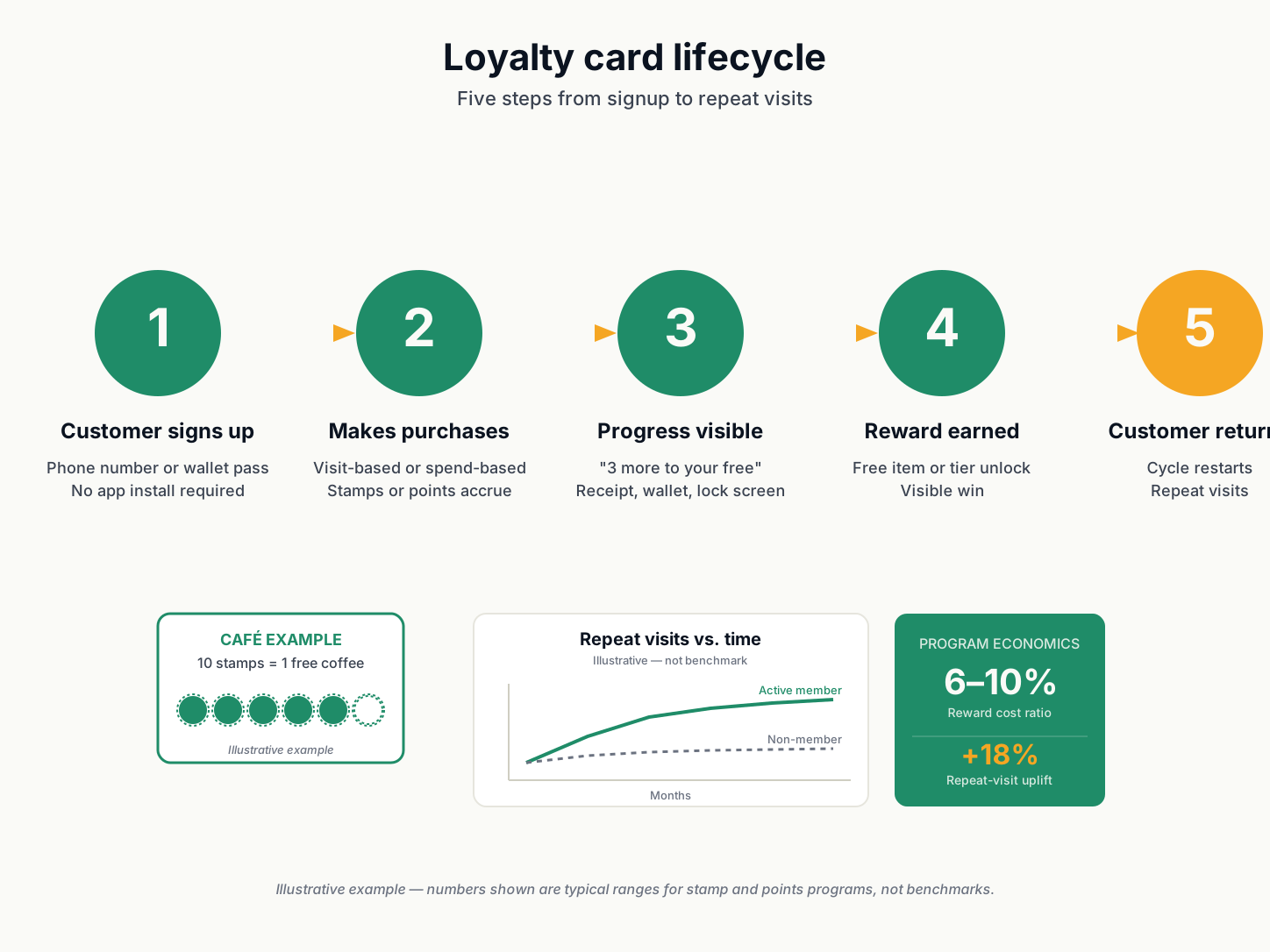
The increase in repeat-visit frequency observed among loyalty-program active members versus non-members. The most-cited success metric in loyalty-program evaluation.
Example: A stamp card program that lifts repeat visits from 50% to 60% in 6 months has a +10 points repeat-visit uplift.
Reward cost ratio
The reward's true cost as a percentage of the customer's cumulative spend required to earn it. A healthy program targets 6–10%.
Example: A free regular coffee costing $1.20 after $50 in spend has a reward cost ratio of 2.4%. Most successful stamp cards target 6–10%.
Stamp
A unit of accrued value in a stamp-card loyalty program, where N stamps (usually 6–12) redeem for one fixed reward.
Example: A 10-stamp "every 10th coffee free" card earns one stamp per coffee visit.
Tier
A status level in a tiered loyalty program, defined by spend threshold or tenure. Tiers unlock recognition rewards.
Example: A retail program's tiers might be: Regular (default), Patron (≥$500/yr), Family (≥$2,000/yr).
Wallet pass
A digital loyalty artifact distributed via Apple Wallet or Google Wallet. Customers receive a pass on their phone; no app install is required.
Example: A coffee shop issues a wallet pass that adds a stamp automatically when the customer scans their pass at the till.